Info Site Registration Participants Program Food Tips
About food: All foods are lactose-free.
In addition to this, we take into account all food restrictions announced in time.
If you want to make our lives easier, tell us what level of allergy/restriction you have – e.g. does the smell or something done in the same space already bother you, or does “may contain the products” work for you, or something between.
If you want, you can also tell us your dislikes or favorites, so we may consider them as well. =)
~~~~~~~~~~~~~~~~~~~~~~~~~~
Plan, changes possible.
Friday
19- evening meal [main hall]
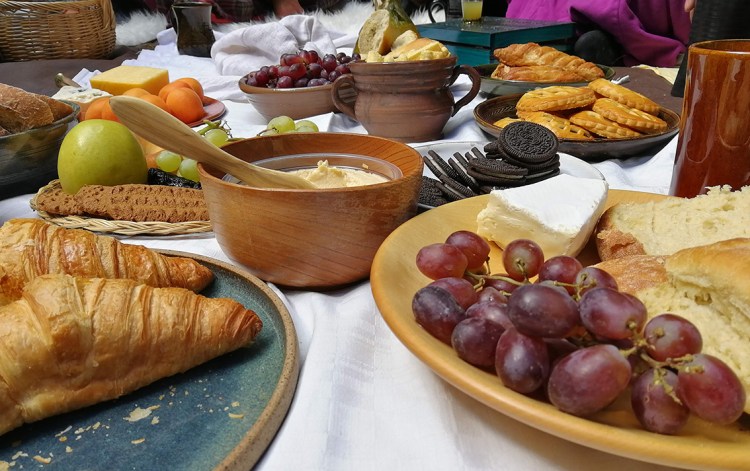
rice pies & egg butter, pancake & jam, bread & toppings, fruit, coffee, tea, juice
Saturday
8-10 breakfast [main hall & Small Hall next to the field]
oatmeal, boiled eggs, bread & toppings, etc., coffee, tea, juice
12-14 lunch [Small Hall next to the field if the weather is not terrible]
cheese pasta & meat and root stew, salad, bread, coffee, tea, juice
16-16.30 tea [main hall]
sweet and savoury pies
feast [main hall]
1. salad, bread, etc.
2. stuffed meatloaf, herbed vegetables, saffron rice, pepper cream sauce
3. blueberry curd, oat biscuits
Sunday
9-11 breakfast [main hall]
left-overs ect.
~~~~~~~~~~~~~~~~~~~~~~~~~~
Feasts are ( in addition to the court) another specialty of medieval events. In them, people sit at tables where food is served as table settings, and there is often a program in between. Depending on the event, diet dishes may come separately for those who need them (and for those who have declared their choice), but otherwise the serving dish goes around the table and everyone takes their part.
For Feast, like other event foods, you need your own medieval-style dishes and cutlery. You should bring a plate, drinking vessel, cutlery and possibly a bowl or deep dish. A small napkin to wipe your fingers, etc., and a dish towel are also handy, as napkins are not provided and the dishes are washed at the event counter.
During the Feast, there can be a program, such as performances, singing, etc., and often also the raising of toasts that are part of the SCA events. The toasts are raised by the highest person not sitting at the head table, and from there it is continued in order on the value scale backwards until all the “mandatory” toasts have been raised. The person giving the toast usually makes a short speech, at the end of which he says what or to whom the toast is for, after which everyone raises their toast, repeating to whom/to whom they are toasting a little (because several toasts are raised). After this, the next person raises a toast, etc. Finally, it is possible for anyone to raise a toast to the thing they want, to which the others then agree.
 Keskiaikaseura Unikankare